Spacetown
The Caves of SteelSpacetown is the Spacer settlement adjoining New York City, a place whose low, individual domes and guarded boundary make the contrast with Earth’s crowded towers visible in the cityscape. It is both the setting of Dr. Sarton’s murder and a political foothold for the Spacers’ effort to push Earth toward renewed expansion and colonization. The investigation’s abrupt end turns that foothold into a departing presence, while the settlement’s security and separation shape the mystery from its beginning to its resolution.
Setting and contrast
From the Commissioner’s window, Spacetown can be glimpsed between the Brunswick Sectors: low domes spread across the land, unlike the towers of New York City, which rise close together. The Commissioner reads this difference as a visible expression of opposed ways of life: on Earth, people crowd upward into great urban structures; in Spacetown, each family has a dome of its own, with land between households. Rain and low visibility sometimes obscure the settlement, but even as a distant view it embodies the cultural distance separating Earthmen and Spacers.
That contrast is not merely architectural. The Commissioner remarks that people on either side may be intolerant of cultural differences, and the death of a Spacer brings that tension directly into the investigation. Spacetown is close enough to be part of New York’s political world, yet its distinct habits and boundaries mark it as a separate society.
Boundary and admission
Established about twenty-five years before the events of the novel, Spacetown initially attracted crowds from the City, who came to see it as a showplace. The Spacers stopped that visitation by placing a force barrier between themselves and New York City. They also established a combined immigration and customs inspection. Visitors with legitimate business had to identify themselves, submit to a search, undergo a medical examination, and be routinely disinfected.
The arrangement made entry a controlled exception rather than an open invitation. The logic is blunt: anyone with business there would know the way, while those without business had no reason to go. For the murder inquiry, this boundary becomes a practical constraint. Elijah Baley points out that a person who entered Spacetown, approached Dr. Sarton, shot him, and left would have had to pass a guarded entrance. R. Daneel Olivaw considers it safe to conclude that no Earthman could have entered illegally.
The normal admission procedure also helps explain why a City-dwelling suspect was cleared. He had entered by the usual process, during which blasters were routinely removed; he had no blaster in his possession, and the investigation found no weapon in Spacetown’s inventory that had recently been fired. The perimeter and its controls therefore do more than separate two communities: they narrow the apparent possibilities of the crime and make the absence of a weapon a central puzzle.
The murder investigation
Dr. Sarton, a Spacer, is reported dead three days before the Commissioner tells Baley about the case. The death makes Spacetown the focus of an inquiry in which the settlement’s security is both a safeguard and an apparent obstacle. If no Earthman could have crossed the official entrance with a weapon, investigators must account for how the killing occurred without assuming that an ordinary City resident simply walked in, committed the crime, and walked out.
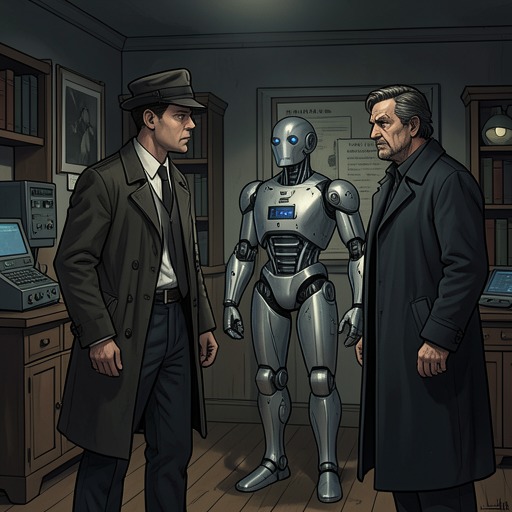
The case eventually turns on a route that bypassed that assumption. Baley’s reconstruction is that the Commissioner first put a blaster into R. Sammy’s hand and directed the robot where and when to go. The Commissioner entered Spacetown through the proper personal entrance and surrendered his own weapon during inspection; R. Sammy later supplied him with the other blaster. After the murder, the Commissioner returned the weapon to the robot, which carried it back across the fields to New York City. Baley further concludes that the Commissioner destroyed R. Sammy once the robot’s knowledge became dangerous. This account uses the open country beyond the regulated entrance to explain how the crime could involve Spacetown’s own procedures without an armed Earthman crossing its checkpoint.
The settlement’s role in the investigation is also shaped by what can be seen from outside it. At the end of the confrontation, a large projected image shows Dr. Sarton’s dome, with his dead body at its center. The image brings the scene of the crime into the room where the case is being argued, linking the distant settlement’s private space to the City’s public reckoning.
Political purpose and withdrawal
Spacetown is not only a guarded enclave or a place of residence; its presence on Earth has a stated political purpose. R. Daneel explains that the Spacers are there to break the shell surrounding Earth and press its people toward expansion and colonization. In his account, pursuing punishment for Dr. Sarton’s murder would not restore the dead man. Rather, failing to pursue the case could strengthen politicians on the Spacers’ home planet who oppose the project that Spacetown represents.
That political calculation changes when the investigation is brought to an end. R. Daneel tells Baley that, following his information, the people at Spacetown have decided to stop investigating Dr. Sarton’s murder and begin plans to leave both Spacetown and Earth. The withdrawal puts the settlement’s future in immediate doubt: the outpost established to influence Earth’s direction is preparing to vanish from it. Yet its departure does not erase its significance. Spacetown has made the differences between Earth and the Spacer worlds concrete—in architecture, admission rules, public health precautions, and political aims—while the murder case exposes how porous even a forcefully maintained boundary can become.